The S/PDIF and USB DAC, and all the bells and whistles, now for less than 1000€
12 April 2008: AYA II review now on TNT-Audio |
27 November 2008: AYA II review now on Mono & Stereo |
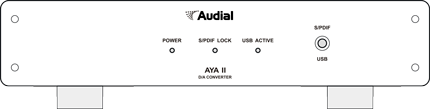
And Audial is proud to offer such a device. And there is much more that makes this unit pretty unique at current market. Despite its relatively low price, it is not exaggerating to say that the AYA II is still able to compete with the best, regardless of budget.
[click to see higher res pictures]
The AYA II should be also considered successor to a couple of DIY DACs published between 2003 and 2006 on the Pedja Rogic DIY audio site, and it gets closer to the Model DACs than any of its predecessors. It however still keeps the DIY friendly nature and is hence offered also in the form of the DIY kits.
Features
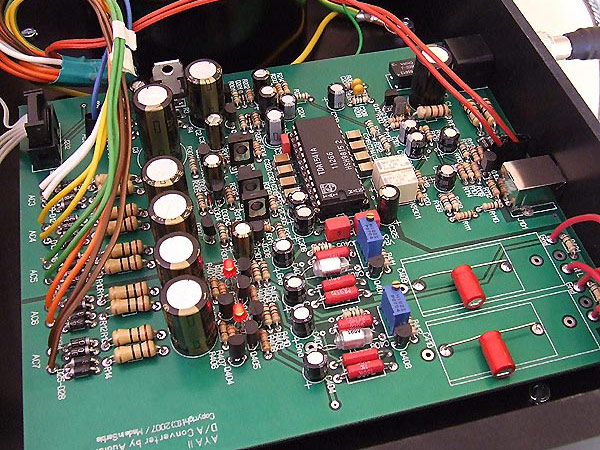
The AYA II uses a TDA1541A converter chip with no oversampling, but similarities with Audial Model D/A converters don't stop here - the AYA II employs the same advanced architecture of multiple galvanically isolated supplies with serious filtering and regulation, differentially transformer coupled S/PDIF line, zero feedback analog stage circuitry, high quality parts and ultimate layout design, to name a few.
There are however also some differences, required for some cost savings, and three of them are the major ones. The first, the AYA II doesn't comprise isolating mains transformer with balanced output. (But you have to realize that Audial Model DACs are probably the only devices on the current market which do.) The second, instead of discrete transistors as in the first Model and hybrid circuit as used in the Model S, the I/V stage of AYA II uses solely integrated circuits. Still, it is very unique open loop transimpedance stage realised by the use of Texas Instruments new OPA861, and the same circuit is also used as an open loop output buffer. It is important to stress this: despite of major use of integrated circuits, the output stage of AYA II operates with zero feedback; it is NOT the opamp output stage. And the third, instead of using transformers, the output of AYA II is capacitively coupled.
The chassis is also less expensive though it is still pretty rigid anodized aluminum. As for the passive parts, there are some differences as well, and these were partially brought about by the cessation of production of Black Gate capacitors. In the AYA II local supply decoupling capacitors are replaced by Rubycon's best ZA series, whereas TDA1541A active divider decoupling capacitors are, just as in new Model S, replaced by polyphenylene sulphide (PPS).
When used with an adequate source, the AYA II will hardly leave anyone indifferent. But probably more important than that, its performance fits the expectations in the longer term. It would be very easy to design for laboratory, and it is still not that hard to design for the "listening test". Even though the AYA II shows its strengths immediately, it was never developed to impress only in the first audition.
It is intended for serious music lovers, for people who spend a significant part of their time listening to the music, still finding some sense in it. Or did this some time ago and are willing to find it again.
The AYA II is available directly from Audial. It is also available as a DIY kit. Additional info on technical aspects of AYA II can be found on AYA II DIY page.