Berliner Philharmonie

Quote from Pedja on 11 February 2026, 11:48 AMMy report from the Berliner Philharmonie might be kinda expected, after those from Hamburg and Rome.
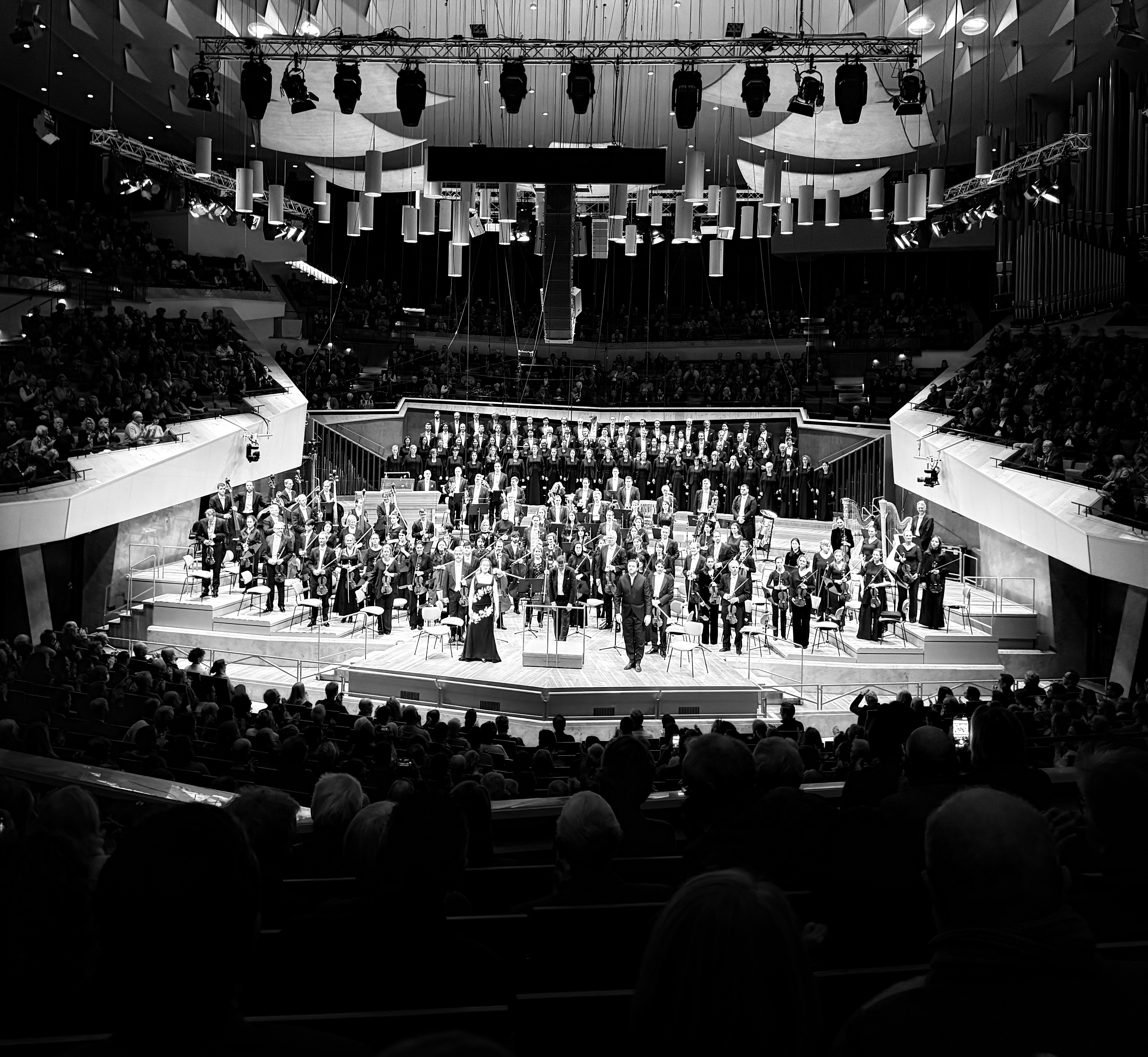
Namely, the Berliner Philharmonie Grand Hall was the original concept and the first concert hall of what is now known and recognized as the vineyard-style hall. It was designed in 1956 by Hans Scharoun, who submitted a very radical concept in his time, to the competition for a new Berliner Philharmonie building, to replace the old one destroyed in the 1944 bombardment. And it was Herbert von Karajan who split his idea from others in the competition and insisted on it. The idea was to replace a classic rectangular ("shoebox") form with a relatively uneven shape, with visitors sitting in several gallery sectors, i.e. sloping terraces (as a vineyard), all around the musicians. In terms of the acoustics, it is the shape that breaks the resonant modes, formed by the usual parallel walls. To me, it is not clear for now if Karajan had a clear idea of the benefits of such a shape regarding the resonances, but he indeed was interested in technology, and for instance was exceptionally interested in the quality of his recordings.
The current Berliner Philharmonie hall was opened in 1963. Later on, several, or maybe even the majority of ambitious concert halls built after this one, including those in Rome (2002) and Hamburg (2017), were built on these or similar premises and propositions.
This January, I was happy enough to pay a visit to it. The Berliner Philharmonie Grand Hall has 2,440 seats, and we were in block B (which seats are, for some reason, actually marked "D", so we have been going in circles for a couple of minutes, looking for our places), row 8, almost in the center, so at pretty good positions, to listen to Brahms' German Requiem, performed by Staatskapelle Berlin, conducted by Christian Thielemann. Could we ask for more?
Acoustically, it is quite close to the Hamburg Elbphilharmonie. Not that "analytical" (any meaning of the analytical in the context of Elbphilharmonie is good), but everything is absolutely precise: unmistakably precise soundstage, with the ultimate audibility and great definition, but with the overall picture which, in some way, may be considered even more/better integrated. Tonally, it is somewhere between the Elbphilharmonie and Santa Cecilia, but without any trace of ringing, ever. Interestingly, its reverberation time is subjectively very short, and the decay dies away almost instantly once the whole orchestra and choir stop even their fortissimo. Later, I checked the reverberation time, and I found my guess to be correct: it is 1.8 seconds for an occupied hall (2.2 seconds unoccupied). Subjectively, to me it sounds even shorter, but the acoustics specialists will know better that the decay does not distribute evenly during the -60dB time, and at all frequencies, and may look for further information on this distribution. Anyhow, a shorter reverberation time than usual may contribute to the overall definition, but the overall picture is not dry at all.Still, for me personally, the Elbphilharmonie remained a reference. But what is amazing about this place is that about 95% of the ultimate acoustics you can experience today had already been achieved by this pioneering undertaking in this domain. It simply brings a fantastic experience.
My report from the Berliner Philharmonie might be kinda expected, after those from Hamburg and Rome.
Namely, the Berliner Philharmonie Grand Hall was the original concept and the first concert hall of what is now known and recognized as the vineyard-style hall. It was designed in 1956 by Hans Scharoun, who submitted a very radical concept in his time, to the competition for a new Berliner Philharmonie building, to replace the old one destroyed in the 1944 bombardment. And it was Herbert von Karajan who split his idea from others in the competition and insisted on it. The idea was to replace a classic rectangular ("shoebox") form with a relatively uneven shape, with visitors sitting in several gallery sectors, i.e. sloping terraces (as a vineyard), all around the musicians. In terms of the acoustics, it is the shape that breaks the resonant modes, formed by the usual parallel walls. To me, it is not clear for now if Karajan had a clear idea of the benefits of such a shape regarding the resonances, but he indeed was interested in technology, and for instance was exceptionally interested in the quality of his recordings.
The current Berliner Philharmonie hall was opened in 1963. Later on, several, or maybe even the majority of ambitious concert halls built after this one, including those in Rome (2002) and Hamburg (2017), were built on these or similar premises and propositions.
This January, I was happy enough to pay a visit to it. The Berliner Philharmonie Grand Hall has 2,440 seats, and we were in block B (which seats are, for some reason, actually marked "D", so we have been going in circles for a couple of minutes, looking for our places), row 8, almost in the center, so at pretty good positions, to listen to Brahms' German Requiem, performed by Staatskapelle Berlin, conducted by Christian Thielemann. Could we ask for more?
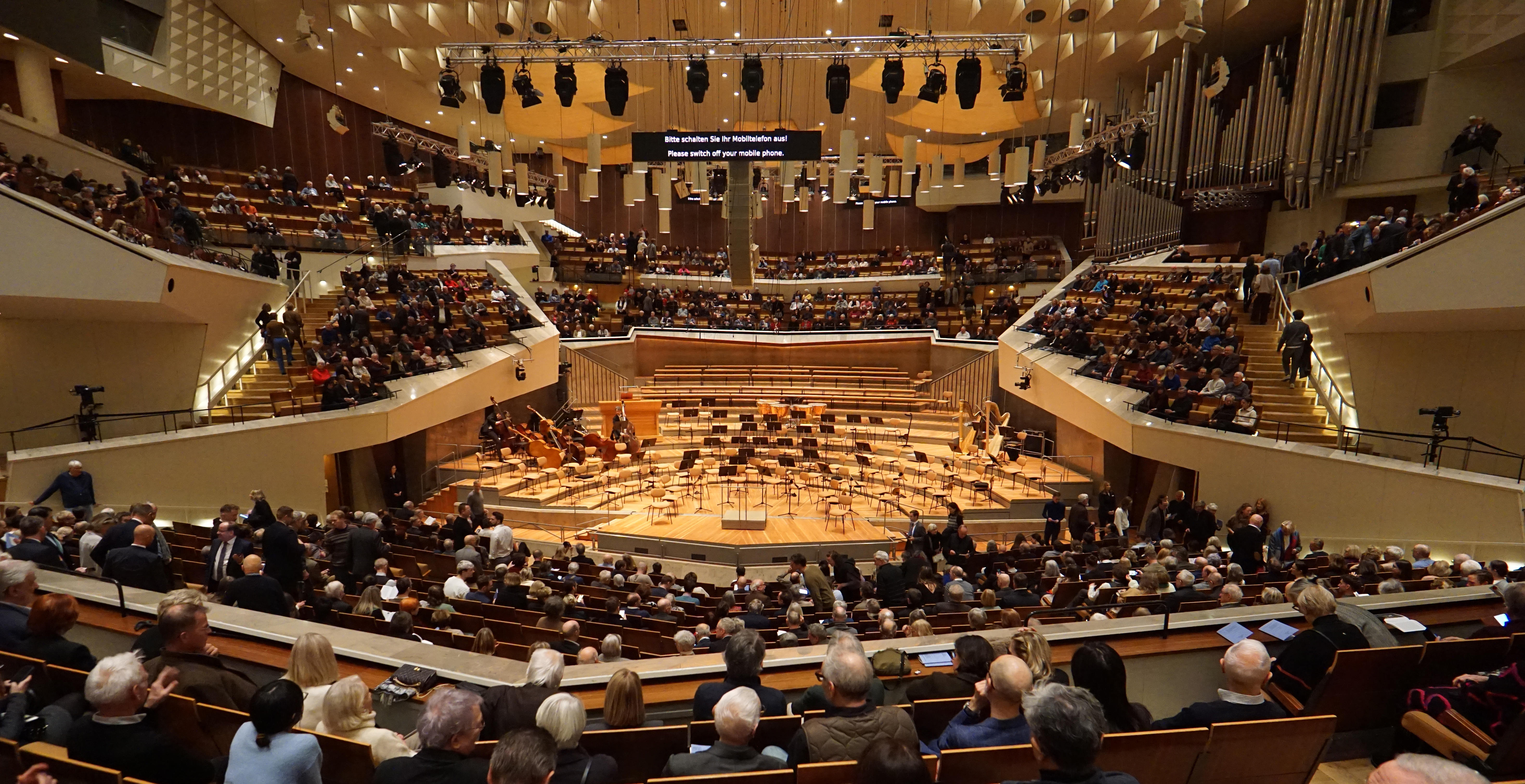
Acoustically, it is quite close to the Hamburg Elbphilharmonie. Not that "analytical" (any meaning of the analytical in the context of Elbphilharmonie is good), but everything is absolutely precise: unmistakably precise soundstage, with the ultimate audibility and great definition, but with the overall picture which, in some way, may be considered even more/better integrated. Tonally, it is somewhere between the Elbphilharmonie and Santa Cecilia, but without any trace of ringing, ever. Interestingly, its reverberation time is subjectively very short, and the decay dies away almost instantly once the whole orchestra and choir stop even their fortissimo. Later, I checked the reverberation time, and I found my guess to be correct: it is 1.8 seconds for an occupied hall (2.2 seconds unoccupied). Subjectively, to me it sounds even shorter, but the acoustics specialists will know better that the decay does not distribute evenly during the -60dB time, and at all frequencies, and may look for further information on this distribution. Anyhow, a shorter reverberation time than usual may contribute to the overall definition, but the overall picture is not dry at all.
Still, for me personally, the Elbphilharmonie remained a reference. But what is amazing about this place is that about 95% of the ultimate acoustics you can experience today had already been achieved by this pioneering undertaking in this domain. It simply brings a fantastic experience.