


Müpa Budapest

Quote from Pedja on 17 February 2026, 7:18 PMBudapest Müpa (Művészetek Palotája – Palace of Arts) is a relatively new building, officially opened in 2005. Yet, contrary to the other concert halls I was writing about by now, its main hall, named Béla Bartók National Concert Hall, with its 1,656 seats, is not a vineyard, but a more conservative style. The acoustics was designed by Russell Johnson, a well-respected acoustics designer, who believed that a certain return to the more classic concert hall shape is necessary, invoking places like Vienna Musikverein, and considering XIX century halls as the best ones so far.
Still, speaking about this hall's shape, things being said, it is not really rectangular. Its notably rounded corners make its shape almost elliptic, which surely helps avoiding what is often called a horn loading (boundary) effect, where corners act like acoustical sources, that both boost a certain part of the audio bandwidth and bring specific resonances. In fact, a convex shape in the front part (where the stage is) changes in the second half of the hall, where it becomes almost concave. In addition, the walls are full of decorative reliefs, partially acting as diffusers. Reliefs as such are not very deep, but they are actually panels that can rotate. So, Müpa is certainly not a shoe-box, but this sort of historical step back in design is nevertheless evident. Anyhow, according to his own words, Johnson expected Müpa Budapest to soon be accepted as the best concert hall in the world.
And, a few days ago, I was there. I could have been visiting it earlier, as Budapest is not far from Belgrade, barely 400 km, and it is a very interesting city, but it was only the second time I stayed there for a night. In my defense, the reason I drove there for the first time, in 2017, was also audio, and it was to visit the Audio Precision seminar. It was not a moment to hear something new in the measurements domain, of course, but meeting AP people was great.
And now, Müpa. Great looking building from the outside.
It was Sunday, the day full of events named English Marathon, which finished with the Hungarian National Philharmonic Orchestra, conducted by János Kovács, playing Britten’s Soirées musicales and Elgar's Enigma Variations. We were on the balcony, 1st floor, because with time I started to prefer the above orchestra level, rather than sitting in line or below, whenever possible. I do not like being too far from the performers, either, but here the balcony is not any far from the stage.As for its acoustics, the first word that comes to mind to describe it, right from the start, is that it is unbelievably convincing. The dynamic is immense, and everything is audible, clear, and tonally seductive and attractive, maybe going a bit to the warm side, but remaining tonally fully open. Nominal reverberation time is 2.2 seconds for the fully occupied hall, and subjectively, it leaves nothing to be desired. I tried several times closing my eyes to check the positioning, and it is all perfect, too. Yet, the strings, and there were 45 on stage, are well integrated. Six double basses can totally fill this space, and on the other end, the xylophone is nice, full-bodied from this distance, open, and very immediate. In all these areas, the hall is absolutely astounding.
What remained as my uncertainty after this was, since the performance we attended took about 45 minutes, with this sort of enthusiastic, intense acoustical presentation, whether the longer listening remains easy or not. Also, along the same lines, I am not sure if I would call all the colors neutral, so I wanted to see the actual frequency response (I would expect it to vary with actual position, too), but I could not find it. It is, however, claimed to be linear and somewhat adjustable by the relief panels.
In any case, this hall is the reference of its own.
Budapest Müpa (Művészetek Palotája – Palace of Arts) is a relatively new building, officially opened in 2005. Yet, contrary to the other concert halls I was writing about by now, its main hall, named Béla Bartók National Concert Hall, with its 1,656 seats, is not a vineyard, but a more conservative style. The acoustics was designed by Russell Johnson, a well-respected acoustics designer, who believed that a certain return to the more classic concert hall shape is necessary, invoking places like Vienna Musikverein, and considering XIX century halls as the best ones so far.
Still, speaking about this hall's shape, things being said, it is not really rectangular. Its notably rounded corners make its shape almost elliptic, which surely helps avoiding what is often called a horn loading (boundary) effect, where corners act like acoustical sources, that both boost a certain part of the audio bandwidth and bring specific resonances. In fact, a convex shape in the front part (where the stage is) changes in the second half of the hall, where it becomes almost concave. In addition, the walls are full of decorative reliefs, partially acting as diffusers. Reliefs as such are not very deep, but they are actually panels that can rotate. So, Müpa is certainly not a shoe-box, but this sort of historical step back in design is nevertheless evident. Anyhow, according to his own words, Johnson expected Müpa Budapest to soon be accepted as the best concert hall in the world.
And, a few days ago, I was there. I could have been visiting it earlier, as Budapest is not far from Belgrade, barely 400 km, and it is a very interesting city, but it was only the second time I stayed there for a night. In my defense, the reason I drove there for the first time, in 2017, was also audio, and it was to visit the Audio Precision seminar. It was not a moment to hear something new in the measurements domain, of course, but meeting AP people was great.
And now, Müpa. Great looking building from the outside.
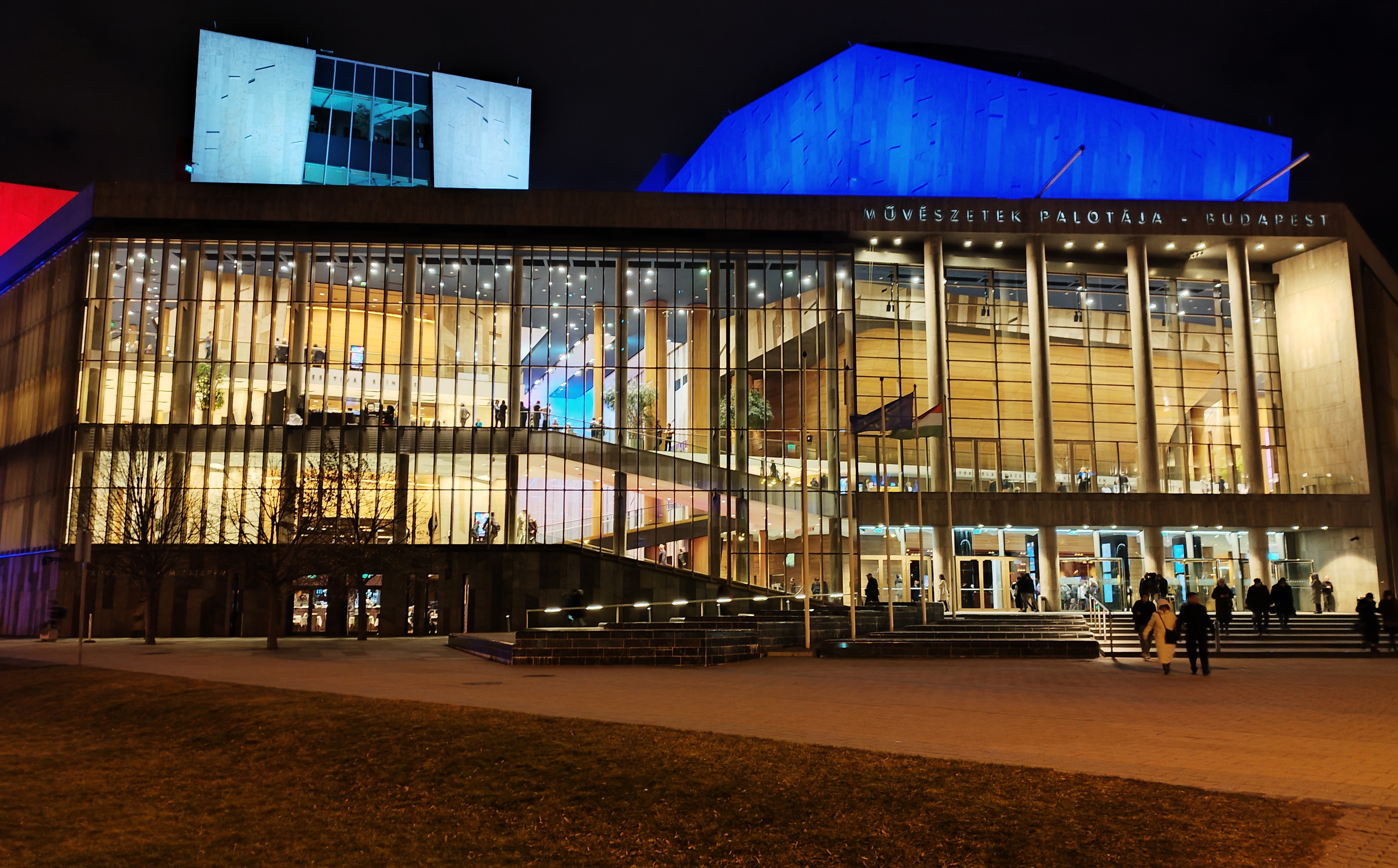
It was Sunday, the day full of events named English Marathon, which finished with the Hungarian National Philharmonic Orchestra, conducted by János Kovács, playing Britten’s Soirées musicales and Elgar's Enigma Variations. We were on the balcony, 1st floor, because with time I started to prefer the above orchestra level, rather than sitting in line or below, whenever possible. I do not like being too far from the performers, either, but here the balcony is not any far from the stage.
As for its acoustics, the first word that comes to mind to describe it, right from the start, is that it is unbelievably convincing. The dynamic is immense, and everything is audible, clear, and tonally seductive and attractive, maybe going a bit to the warm side, but remaining tonally fully open. Nominal reverberation time is 2.2 seconds for the fully occupied hall, and subjectively, it leaves nothing to be desired. I tried several times closing my eyes to check the positioning, and it is all perfect, too. Yet, the strings, and there were 45 on stage, are well integrated. Six double basses can totally fill this space, and on the other end, the xylophone is nice, full-bodied from this distance, open, and very immediate. In all these areas, the hall is absolutely astounding.
What remained as my uncertainty after this was, since the performance we attended took about 45 minutes, with this sort of enthusiastic, intense acoustical presentation, whether the longer listening remains easy or not. Also, along the same lines, I am not sure if I would call all the colors neutral, so I wanted to see the actual frequency response (I would expect it to vary with actual position, too), but I could not find it. It is, however, claimed to be linear and somewhat adjustable by the relief panels.
In any case, this hall is the reference of its own.
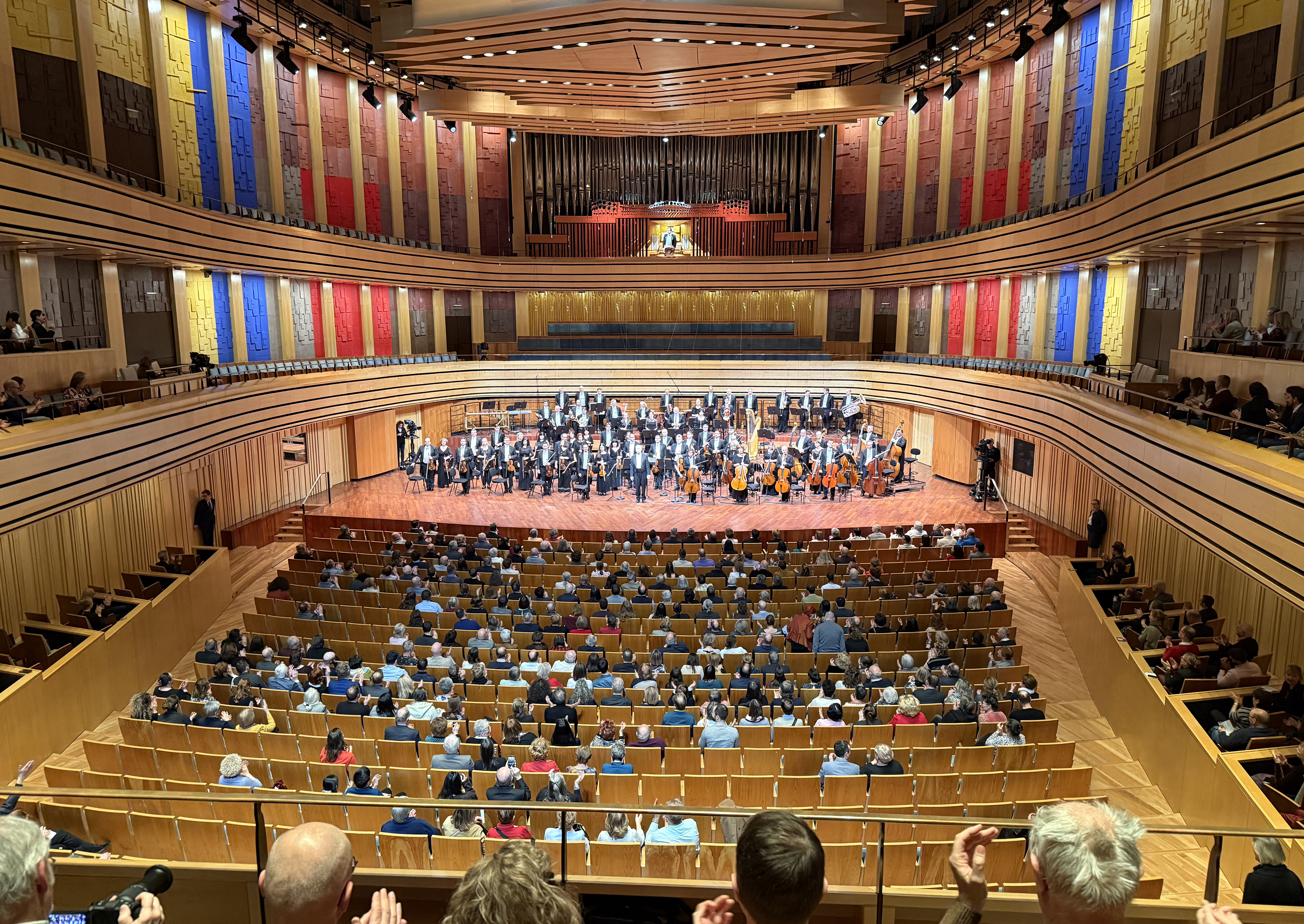

Quote from Pedja on 31 August 2026, 3:58 PMWe were in Budapest once again in June, and we were just walking through City Park. A beautiful place.
And we stopped at the Bela Lugosi statue to take some pictures, but we were unaware that, about 100 meters away, there was more to see. Now, looking for it: the way Japanese architecture blends into a park setting certainly rings a bell.
So, thanks. I will check Magyar Zene Házas' schedule and try to book something.
We were in Budapest once again in June, and we were just walking through City Park. A beautiful place.
And we stopped at the Bela Lugosi statue to take some pictures, but we were unaware that, about 100 meters away, there was more to see. Now, looking for it: the way Japanese architecture blends into a park setting certainly rings a bell.
So, thanks. I will check Magyar Zene Házas' schedule and try to book something.